
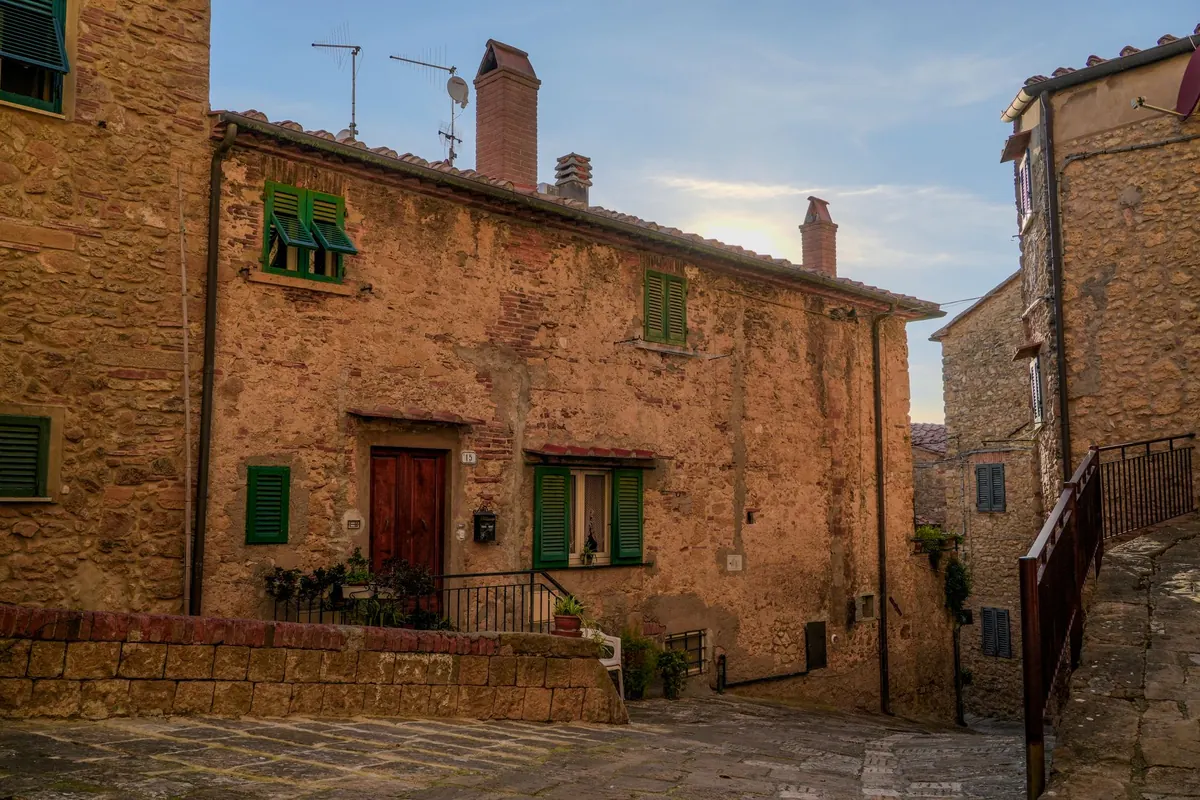
Every Tuscan itinerary has the same three squares on it, and by mid-morning in July they are a scrum of selfie sticks and coach groups. The smaller squares are different. They are where the bar keeps a stool for the same man at eight every morning, where the parish priest stops to argue about football, where a summer festival is organised by people who have known each other since primary school. They take a detour to reach and they reward one. Here are six worth the extra kilometres, arranged roughly north to south.
Barga: the terrace in front of the Duomo
The climb through Barga's old town is steep, cobbled and entirely without shortcuts, but it ends in one of the finest small squares in the Garfagnana. The Piazza del Duomo is less a square than a stone terrace laid in front of the Romanesque church of San Cristoforo, with the Serchio valley falling away on three sides. Sit on the low wall and you can watch weather move across the Apuan Alps while the bell tower does its work.
Concerts and the late-summer jazz festival use the square and the church steps as a stage, and on those evenings the whole town seems to be out. Otherwise it belongs to a handful of people, a few cats and whoever is sweeping.
Practical: drive up from Lucca along the Serchio valley, or take the train to Barga-Gallicano and walk up. Parking in the lower town is easier than in the old centre, where the streets are narrow and the gates tight. Wear shoes with grip — the paving is polished by centuries of feet and slippery when wet. Go early in the morning for the light, or an hour before sunset.
Scarperia: Piazza dei Vicari
Scarperia's square is long rather than wide, closed at one end by the Palazzo dei Vicari, whose facade is covered in the stone coats of arms of the Florentine officials who governed here. It is a strange, dense piece of history to meet on a Monday morning, and the town carries it lightly: the arcades below hold knife workshops and shops, a trade the Mugello has kept alive for centuries.
There is a bar with tables under the portico, a church a few steps away, and a rhythm that has not changed much. Weekday mornings are best — the square belongs to locals, deliveries and bicycles.
Practical: leave the A1 at Barberino di Mugello and follow signs; it is only a few minutes further. Scarperia makes a good stop on the way north or south, but check the calendar if you are staying overnight: race weekends at the nearby circuit fill every bed in the area.
Suvereto: Piazza dei Giudici
Suvereto sits above the Val di Cornia, a short climb inland from the Etruscan coast, and its main square is a compact, well-proportioned room of stone: the Palazzo Comunale on one side, the church of San Giusto on another, and a few tables belonging to the bar. There is nothing to tick off here. That is the point.
This is a good square for the ordinary rituals — an espresso at eleven, a plate of something simple at one, a slow circuit after dinner. In summer there are small festivals and music; in winter it is very quiet, and the light on the stone is lovely.
Practical: come off the Aurelia near Venturina Terme or Campiglia Marittima and head uphill. Cars stay outside the walls, and the walk in is short. Spring and autumn are ideal; in August, arrive before noon or after five. It pairs naturally with a beach afternoon or with a visit to the archaeological park at Baratti.
Lucignano: Piazza del Tribunale
Lucignano is built in rings, and the main square is the yolk of the egg. The Collegiata and the Palazzo Comunale face each other across a space that is slightly too big for the town and all the better for it. In the museum a few doors away is the Albero d'Oro, a gilded reliquary tree that has become the symbol of the place.
What happens here is ordinary and good: children doing laps on bicycles, a wedding party spilling out of the church, outdoor tables in the summer evenings, the flag-throwers practising before a festival.
Practical: easiest from the A1 at Valdichiana, then a short drive through the flatlands towards Monte San Savino and Foiano della Chiana. Park below the walls. It is a compact visit — two hours is enough — so combine it with a longer stop in Arezzo or a meal in the surrounding countryside.
Monticchiello: the village square
Monticchiello clings to a ridge above the Val d'Orcia, and its small piazza in front of the church of Santi Leonardo e Cristoforo is the whole of its public life. For most of the year that means a bench, a bar, a view over the clay hills and not much else. Then, in July and August, the villagers write and perform their own play — the Teatro Povero — in the streets and squares of the village, using their own lives, arguments and fears as the material.
It is not a folkloric show put on for visitors. It is a community talking to itself in public, and that is exactly why it is worth planning a trip around.
Practical: a short drive east of Pienza on a narrow road; park outside the walls, as the lanes inside were not built for cars. If you are coming for the theatre, book well ahead and stay the night — the few tables around the square fill quickly, and the drive back in the dark is winding. From the walls, the walk along the perimeter takes ten minutes and gives you the best of the valley.
Sovana: Piazza del Pretorio
Sovana is tiny, and its main square is really a widening of the street, framed by the Palazzo Pretorio with its shields and the church of Santa Maria. Half an hour is enough to see it; an afternoon is not too long to stay, especially if you walk down to the Etruscan tombs outside the village, where the Tomba Ildebranda sits cut into the tufa.
Come in the morning when the light comes sideways down the street, or in the late afternoon when the stone turns the colour of honey. In between, in high summer, it is hot and very still.
Practical: reach it from the Aurelia via Manciano, or on the winding roads between Pitigliano and Sorano. The last stretch is slow but beautiful. Fill the tank before you leave the main road, park at the edge of the village and walk in. The tufa paths to the tombs are uneven and can be slippery after rain.
Practical notes before you set off
These are small places, and small places keep small hours. A little planning makes the difference between a lovely day and a closed door.
- Check opening hours twice. Bars and trattorie in villages this size often close in the afternoon and take a weekly rest day, sometimes unpredictably.
- Park outside the walls. Historic centres have limited-traffic zones and narrow gates; the fine is not worth the ninety seconds you save.
- Assume buses are thin. Services exist but can be infrequent, especially on Sundays and in August; confirm current timetables rather than trusting memory or old blog posts.
- Carry cash for small purchases and keep water in the car — the last kilometres to these villages are usually uphill and without services.
- Two squares a day is plenty. The pleasure here is in sitting still, not in counting villages.
Pairing them up
Barga and the Garfagnana deserve a full day, ideally with a walk in between. Scarperia slots neatly into a drive over the Apennines. Suvereto works with the coast; Lucignano with Arezzo or the Valdichiana. Monticchiello and Sovana are far enough south to plan separately, and both reward an overnight stay rather than a flying visit.
Best seasons
Late April to early June, and September into October. The light is good, the tables are out, and you can park without circling. If you come in July or August, do as the locals do: mornings and evenings outdoors, the middle of the day behind a shaded window with a long lunch.
Photo: Paul Scheelen / Pexels
Related posts
More stories you’ll love reading