
Most visitors treat a piazza as a photograph stop: arrive, look up at the facade, take the picture, leave. That misses the point. A piazza is a room without a roof, and like any room it has a floor, walls, furniture and a favourite chair. Learn to see those four things and the square stops being scenery. You start noticing which corner the locals claim at six in the evening, why one café is full and the one beside it is empty, and how a space that felt enormous at noon can shrink to something intimate after dark. It takes about ten minutes of deliberate looking. Here is what to look for.
Begin With the Floor
The paving is the first thing to read, because it is where a square's history and its traffic are written. Look at the material under your feet. Rome's sampietrini — the small dark basalt cubes — tell you the space was built for carts and horses and is now hard on heels. Siena's Piazza del Campo is brick, laid in a fan of divisions and sloping like a shell toward the Palazzo Pubblico. That slope is not decoration: it turns the square into a natural amphitheatre where people sit on the ground without needing a bench. Travertine, porphyry, bands of white marble, a patch of plain asphalt where the pipes were dug up: each sets a different pace.
Then look at the lines. In many squares, stone bands run from the entering streets toward the centre, or a circle of paving marks an old well, a market cross, or the footprint of a demolished building. Those lines are instructions left by the people who laid them out, telling you where to walk and where to pause. Level changes matter just as much. Two shallow steps across the middle of a square will divide it into two rooms that people treat completely differently, even when nothing else separates them.
Read the Edges Before the Middle
People rarely occupy the centre of a piazza unless something is happening there. They occupy the edges, and the edges explain why.
A square's walls are the rows of buildings around it, and the most useful of them are the ones with a portico — Bologna's arcades are the classic case, but you'll find them in most Italian towns. A portico is a shaded corridor, a place to walk when it rains, and a place to stand and watch without being watched. Where a square has one, you will find people lingering under it even when the middle is empty.
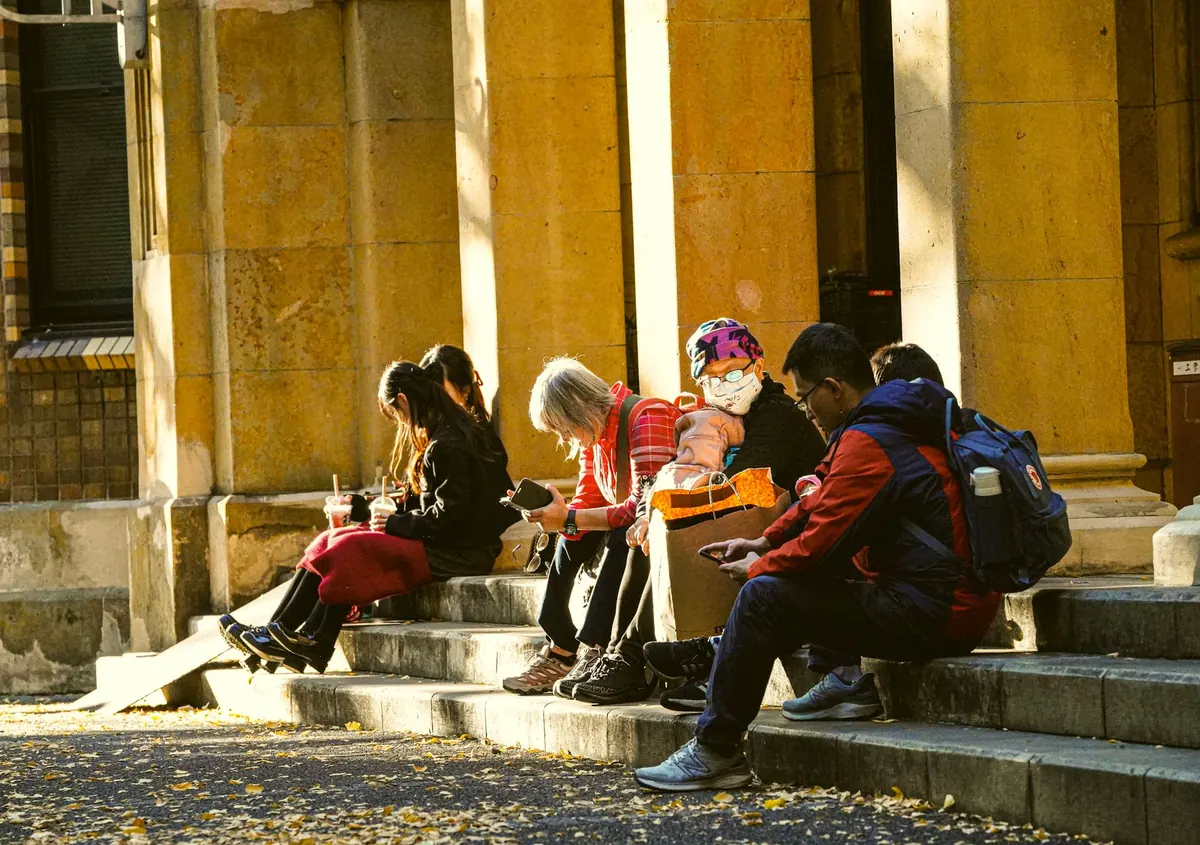
Next, catalogue the furniture along the edge: steps, low walls, bollards, benches, bike racks, the stone rim of a fountain, the base of a statue. Each is potential seating. In an Italian square the church steps are usually the best seats in the house, and sitting on them is broadly accepted as long as you keep clear of the doors and don't hold a full picnic there during Mass. Notice also where chairs have been allowed to spill out of a bar onto the paving. That is a landlord's bet on which side of the square gets the afternoon sun, and it is rarely wrong.
Locate the Focal Points
Every piazza has at least one thing that pulls people's eyes, and usually two or three competing for the job. Find them, then note where they sit relative to each other.
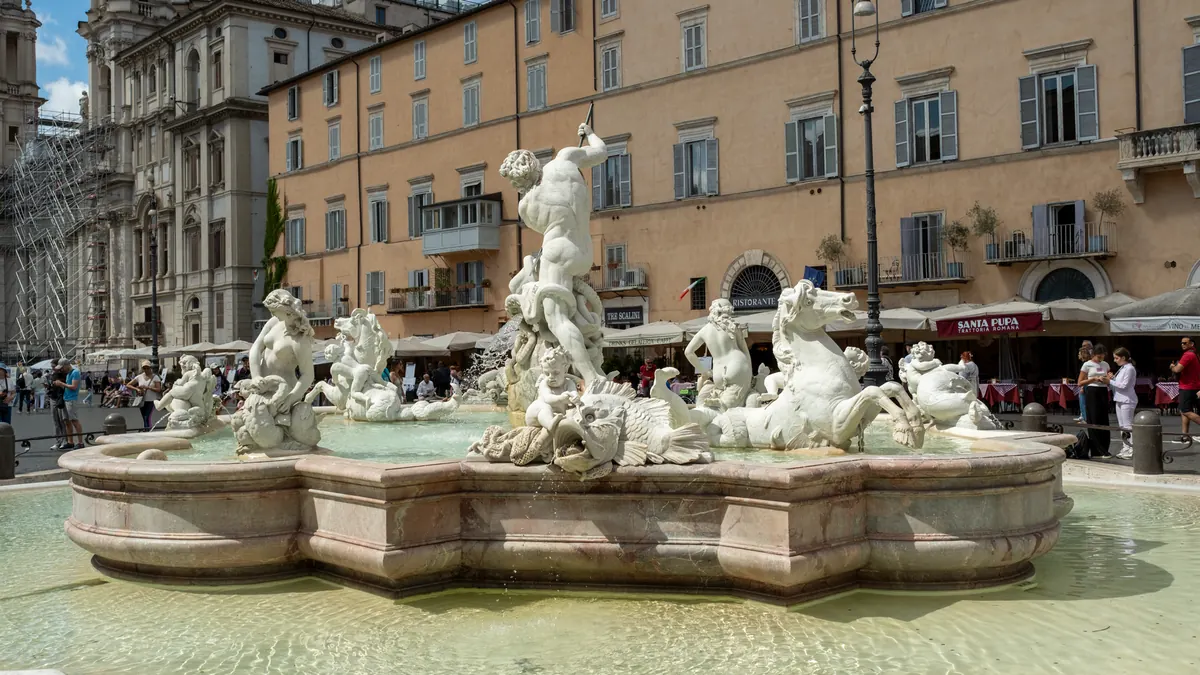
The obvious candidate is the tall one: a church facade, a clock tower, a civic palace with a balcony. But the working focal point is often lower down — a fountain, an obelisk, a bronze figure on a horse. Watch what people do around it. A fountain with a wide rim becomes a meeting point, a seat, a place to fill a bottle. A statue on a high plinth ringed with iron railings does almost nothing socially; it decorates, it doesn't gather. Piazza Navona is a good test case. It has three fountains and a long, stadium-shaped plan, and the crowd's attention drifts down its length as the light changes rather than fixing on any single building.
One more thing to notice: alignment. Some squares are arranged so that a street entering at one corner points straight at a dome or a statue. When you find that line, you have found the view the designers wanted you to have — and probably the best place to stand.
Spot the Gathering Places
This is the practical heart of reading a square. Don't guess; use signals.
- Convergence. Watch for two or three minutes. Any spot where four or more sets of people arrive from different directions and stop within a few metres of each other is a meeting point, whether or not there is a bench.
- Orientation. People turn their chairs, or stand, facing the square rather than away from it. Find the row of seats facing outward and you have found the front row.
- Shadow. In summer, the shaded strip along one side is the real square between noon and four. The sunny side will be deserted unless it is January.
- Sound. A busker, a fountain, a knot of kids playing football: the loudest zone usually has the loosest etiquette and the most tolerance for lingering.
- Wear. Overflowing bins and a ring of cigarette ends on the paving mark a place where people stand for a long time. Not glamorous, but reliable.
- The awkward corner. Every square has one. It is usually the corner nearest the traffic, or the one with no shade and no view. Note it, and note why.
Watch the Clock
A piazza keeps a schedule, and one visit shows you one hour of it. Come back at a different time and the same space behaves like a different room.
In the morning a market square belongs to traders: vans, crates, awnings, a fast and purposeful crowd. Campo de' Fiori in Rome sells produce early and drinks late, and the two shifts barely acknowledge each other. Mid-afternoon the square empties; shutters come down and the cafés keep a few tables for people with nowhere else to be. Then, in the early evening, the passeggiata arrives — families, couples, groups of teenagers walking a slow circuit with no destination. Watch which route they take. That loop, invisible on any map, is the square's main street.
Late at night the edges take over completely. The centre, so full at six, becomes a crossing to be got across quickly.
A Ten-Minute Routine
If you want to read a square properly, do it in this order.
- Walk the perimeter once, close to the buildings, noting porticoes, benches, doorways and bar terraces.
- Stand in the middle for two minutes and list what draws your eye. More than three draws is a busy square; one is a stage set.
- Find the seats, sit in them, and look at what they face.
- Follow the locals' loop, if there is one, in the direction they walk it.
- Return once at a different hour, ideally early morning or dusk, and compare the two readings.
Then stop analysing and order a coffee. The point of all this is not to grade the architecture. It is to notice the difference between a square you walk through and a square you use — and, after a while, to sit down in the right place without having to think about it.
Photo: Sean P. Twomey / Pexels
Related posts
More stories you’ll love reading